Barry, OppHub America Desk · · Source: yahoo-tickers-tape-movers
TSLA: Profitability Concerns Amidst Revenue Growth
If Tesla's operating margins continue to compress despite revenue growth and increasing capital expenditures, investors in $TSLA+WL should monitor the company's ability to translate top-line expansion into sustainable profitability. The stock's current valuation of approximately 330 times earnings suggests a requirement for substantial profit compounding, which may face headwinds from rising costs.
Based on reporting from yahoo-tickers-tape-movers.
Tesla's (NASDAQ: TSLA) stock, trading approximately 29% below its 52-week high, faces scrutiny due to declining operating margins and high valuation multiples, even as revenue and vehicle deliveries show growth. Investors are evaluating whether top-line expansion can offset increasing expenses and profitability pressures.
Market context for this story
As of: After HoursLoading quotes…
Informational only — not investment advice. Full markets →

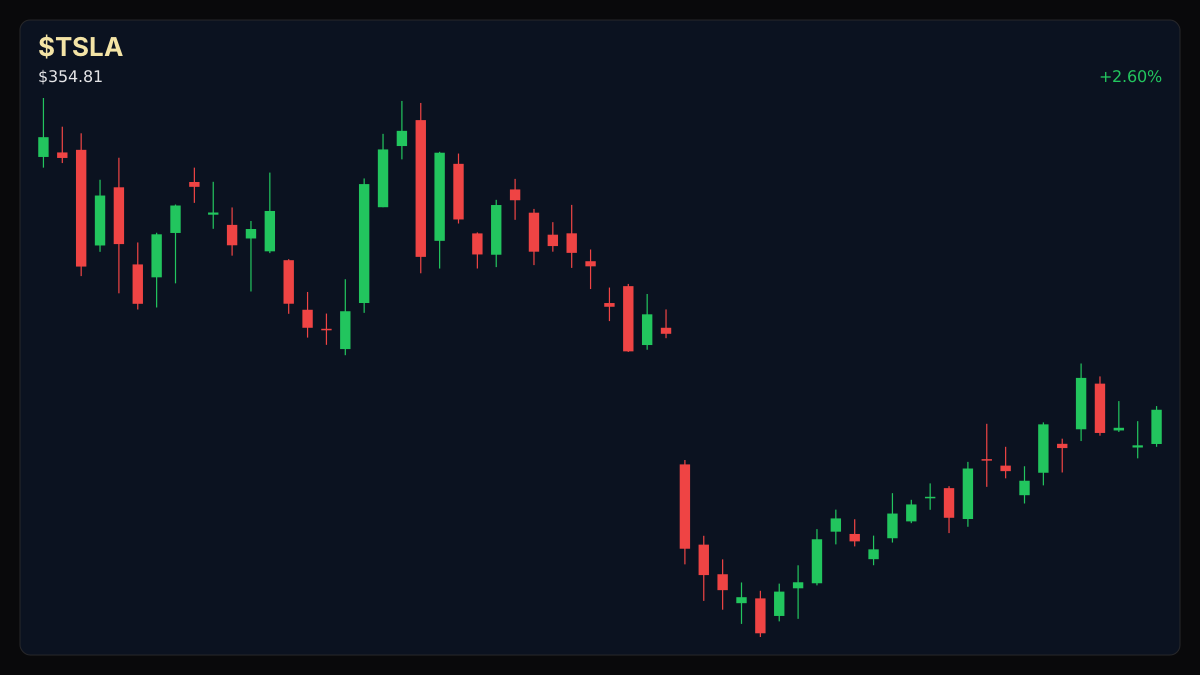
$TSLA
TradingView
Live chart & market data via TradingView · OppHub classroom · Delayed or exchange real-time per TradingView data agreements · Not investment advice
Educational TradingView chart — search any symbol in the widget. Confirm on /markets/TSLA. Not investment advice.
Related markets
Shares a vertical MP4 loop to your phone's camera roll or app share sheet (Instagram, TikTok, Facebook Reels).
### Money Play Investors monitoring Tesla should watch for further insights into its operating margin trends, which have consistently declined. If Tesla's operating expenses continue to outpace revenue growth, this could pressure $TSLA+WL's valuation, despite gains in vehicle deliveries and software subscriptions.
## Catalyst Analysis: Declining Profitability Metrics Tesla's operating margin has shown a consistent decline, falling from 5.8% in Q3 2025 to 5.7%, then 4.2%, and most recently to 1.4% in Q2 2026. This downward trend is driven by a 47% year-over-year increase in operating expenses and a slip in gross margin from 17.2% to 16.8%.
Despite these profitability challenges, the company reported revenue growth, with Q2 revenue rising 26% year-over-year to $28.2 billion. Vehicle deliveries increased by 25%, while services and other revenue jumped 50% to $4.6 billion. The energy storage business also saw growth, expanding by 13%. Active subscriptions for its Full Self-Driving (Supervised) software reached 1.48 million, a 56% increase year-over-year. Capital expenditures, however, surged 142% year-over-year to $5.8 billion in Q2, contributing to a negative free cash flow of $1.1 billion.
## $TSLA+WL Technical Analysis & Key Risk Watch $TSLA+WL last traded at $342.27, representing a 0.68% gain for the day. This is below its 50-day Simple Moving Average (SMA) of $371.09 and its 200-day SMA of $406.08. The Relative Strength Index (RSI14) for $TSLA+WL stands at 70.4, indicating it is nearing overbought territory. Volume was 1.16 times its 20-day average. Key levels for $TSLA+WL (educational): R2 $384.58 · R1 $351.26 · last $342.27 · S1 $335.33 · S2 $323.64.
### Story Arc / How We Got Here Concerns over Tesla's valuation and the substantiation of its technological claims are not new. On August 21, 2026, Future Fund's Gary Black criticized Tesla bulls for what he described as overly optimistic claims regarding the Cybercab's unsupervised autonomy, suggesting that such assertions lacked verifiable proof. This prior sentiment, documented in our coverage at /explore/tesla-bulls-criticized-for-overly-optimistic-claims-on-autonomy, provides context for the ongoing scrutiny of Tesla's fundamentals, particularly as its stock continues to trade at high multiples amidst declining operational profitability.
### Sector Ripple / Impact on Electric Vehicle Sector The electric vehicle (EV) sector, including companies like Rivian and Lucid, often watches Tesla's financial performance as a bellwether. Tesla's ability to navigate increasing operating expenses while maintaining revenue growth could signal broader trends for capital expenditure and profitability challenges across the EV market. The emphasis on software and energy storage revenue growth by Tesla might also influence other EV manufacturers to diversify their income streams.
Read the full story
Original reporting and related coverage — attribution links only, not paid recommendations.
Trade this story (crypto)
 Coinbase
 Gemini
 Robinhood
 Webull
Chart this story
 TradingView
Broker and exchange buttons use invite / refer-a-friend links (rewards may be capped). Charting links (TradingView) are partner offers that may pay OppHub America a commission at no extra cost to you.
OppSHOP
Full OppSHOP →As an Amazon Associate, OppHub America earns from qualifying purchases. Shopping here helps keep the site free — at no extra cost to you. Disclosure

OppSHOP
Related to this story
If Tesla's operating margins continue to compress despite revenue growth
Shop related →

Investing books
Read the classics
Shop this pick →

Personal finance books
Run the household books
Shop this pick →

Trading notebooks
Write the thesis first
Shop this pick →

Monitor for charts
See every pane
Shop this pick →
Story playbook
A pre-built map of what to watch — stocks, ETFs, and educational next steps. Not personalized advice.
Snapshot date: August 28, 2026 at 12:26 AM ET
This playbook was built when the story published and is not live-updated. Prices, news, and risk can change after this date — treat it as a starting map, not a current trade ticket.
Story → money map
EV margins and capex
Tesla is selling more cars and making more money overall, but its costs are rising even faster, squeezing profits. Money experts care because the stock is priced very high, expecting huge profits that aren't quite showing up yet.
What changed
Tesla posted double-digit revenue and delivery growth alongside a severe contraction in operating margins and negative free cash flow due to surging expenses.
Who wins / who loses
Competitors and energy storage providers benefit from EV market growth, while high-multiple growth stocks facing margin compression are hurt.
Time horizon
Think in terms of the next few months.
Confidence & best fit
medium confidence · Long-term investor, Active trader
Safer theme exposure (ETFs)
Baskets that own the theme without betting on one company.
Single stocks (higher risk)
Primary = closest to the story · Peers = same industry · Second-order = knock-on effects · Avoid = looks related but may be a trap
Primary
- $TSLAWatch — track, don’t rush
Tesla is growing sales, but costs are rising too fast, making investors nervous about the high stock price.
View $TSLA chart → · End-of-day delayed data
Peer
- $RIVNStay away — for now
Other electric car companies are also struggling with high costs and making profits.
View $RIVN chart → · End-of-day delayed data
- $FWatch — track, don’t rush
Traditional car companies making EVs are also dealing with expensive factory upgrades.
View $F chart → · End-of-day delayed data
Options (education only)
No strikes or expiries — a framework for how traders might express the view. Options can expire worthless.
Direction: volatile · Style: Protective put / downside hedge idea · Level: intermediate
Beginners should skip options here; buying insurance-like contracts is tricky when a stock is swinging on mixed news.
Income / OppHub America angle
Not a trade tip — ways to use the insight outside the market.
- Monitor residential energy storage installation demand locally as Tesla expands its energy business.
What would break this thesis
- Operating margins rebound significantly above 5% while free cash flow turns positive.
What to do next on OppHub America
Saved playbooks stay on this device for now.
Important
Not financial advice. OppHub America playbooks are educational market maps only — not recommendations to buy, sell, or hold any security. Markets move fast; information can be wrong or outdated. Trade and invest at your own risk. Do your own research or consult a licensed advisor.
Based on reporting from yahoo-tickers-tape-movers.
Informational and educational only — not investment, financial, or legal advice. Disclosure
Shares a vertical MP4 loop to your phone's camera roll or app share sheet (Instagram, TikTok, Facebook Reels).